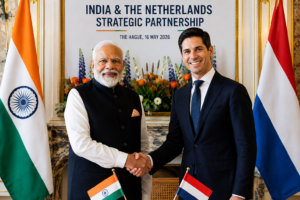
PM Modi’s Visit to the Netherlands: A Strategic Turning Point in India–Europe Relations
The recent visit of Narendra Modi to the Netherlands represents far more than a routine diplomatic engagement. It marks a significant strategic moment in the evolving partnership between India and Europe at a time when the global economy is being reshaped by technology, sustainability, geopolitical shifts, and supply chain transformation.
As one of Europe’s most advanced economies and a global leader in logistics, semiconductors, agriculture technology, water management, and sustainable innovation, the Netherlands plays a critical role in Europe’s economic ecosystem. India, meanwhile, is emerging as one of the world’s fastest-growing major economies and a trusted global partner for manufacturing, digital innovation, and investment.
Together, the two countries are building a partnership designed for the future.
A New Era in India–Netherlands Relations
During the official meetings in The Hague, both nations emphasized their commitment to deepening cooperation across strategic sectors including:
- Trade and investment
- Semiconductor technology
- Artificial intelligence
- Renewable energy
- Defence and maritime security
- Climate action
- Logistics and supply chains
- Smart infrastructure
- Innovation and startups
The visit reinforced the idea that India and the Netherlands are no longer connected only through traditional trade relations. Instead, the partnership is evolving into a broader strategic alliance focused on technology, sustainability, and economic resilience.
This is particularly important in today’s global environment where nations are looking to diversify supply chains, strengthen trusted partnerships, and accelerate innovation-led growth.
Why the Netherlands Is Strategically Important for India
The Netherlands holds enormous importance for India’s long-term European strategy.
The country is home to the Port of Rotterdam, Europe’s largest seaport and one of the world’s most sophisticated logistics hubs. Rotterdam serves as a major gateway to the European Union market, providing direct access to over 440 million consumers.
The Netherlands is also:
- One of India’s top European trading partners
- Among the largest foreign investors in India
- A global leader in sustainable innovation
- A major technology and startup ecosystem
- A hub for advanced semiconductor manufacturing technology
For Indian exporters and businesses, the Netherlands offers:
- Excellent infrastructure
- Strong regulatory systems
- Access to European distribution networks
- A business-friendly environment
- High innovation capacity
This makes the country a natural strategic partner for India’s global economic expansion.
Semiconductor Partnership: Building the Future Together
One of the most important aspects of Prime Minister Modi’s visit was the focus on semiconductor cooperation.
The Netherlands is home to ASML, one of the most critical technology companies in the global semiconductor industry. ASML produces advanced lithography machines used to manufacture the world’s most sophisticated microchips.
Semiconductors are now at the center of:
- Artificial intelligence
- Smartphones
- Electric vehicles
- Data centers
- Defence systems
- Consumer electronics
- Cloud computing
India’s ambition to become a global semiconductor manufacturing hub aligns naturally with Dutch expertise.
The discussions between the two countries focused on:
- Semiconductor supply chains
- Electronics manufacturing
- Research and development
- Technology transfer
- Innovation partnerships
- Talent development
This collaboration could become a game-changer for India’s electronics and digital economy.
Trade and Investment Opportunities
Economic cooperation between India and the Netherlands has been growing steadily over the past decade.
Dutch companies are increasingly investing in India across sectors such as:
- Renewable energy
- Food processing
- Smart logistics
- Port development
- Water management
- Agriculture technology
- Digital infrastructure
At the same time, Indian companies are using the Netherlands as a base for expanding into European markets.
Several sectors are expected to benefit significantly from stronger India–Netherlands cooperation:
- Ecommerce
- Beauty and cosmetics
- Pharmaceuticals
- Technology services
- Clean energy
- Electric mobility
- Manufacturing
- Consumer goods
- Financial technology
For Indian entrepreneurs and exporters, the Netherlands offers a strategic entry point into Europe’s massive consumer market.
Sustainability and Green Energy Collaboration
Climate and sustainability formed another major pillar of the discussions.
Both countries agreed to strengthen collaboration in:
- Green hydrogen
- Offshore wind energy
- Solar energy
- Circular economy solutions
- Sustainable shipping
- Carbon reduction technologies
- Climate adaptation
The Netherlands is globally respected for its expertise in water management and flood protection systems. As India develops smart cities and modern infrastructure, Dutch expertise can contribute significantly to building resilient urban ecosystems.
The sustainability partnership between the two countries aligns strongly with:
- India’s renewable energy targets
- Europe’s Green Deal objectives
- Global climate action goals
This cooperation is expected to drive innovation and investment in clean technologies for years to come.
Innovation, Startups, and the Digital Economy
India and the Netherlands also discussed strengthening ties in innovation and emerging technologies.
The Netherlands has one of Europe’s most dynamic startup ecosystems, particularly in:
- Deep technology
- Artificial intelligence
- Health technology
- Agri-tech
- Sustainable innovation
- Financial technology
India, now home to one of the world’s largest startup ecosystems, offers enormous opportunities for collaboration.
Future partnerships are expected in:
- AI research
- Quantum computing
- Cybersecurity
- Smart mobility
- Cross-border ecommerce
- Digital payments
- Innovation accelerators
The visit highlighted how India-Europe relations are increasingly being shaped by innovation and technology-led partnerships.
The Importance of the Indian Diaspora
Prime Minister Modi also addressed the Indian diaspora during the visit, recognizing their important role in strengthening relations between the two nations.
The Indian community in the Netherlands has made remarkable contributions in:
- Information technology
- Healthcare
- Academia
- Engineering
- Entrepreneurship
- Financial services
The diaspora continues to act as a bridge connecting Indian and Dutch businesses, cultures, and innovation ecosystems.
People-to-people ties remain one of the strongest foundations of the India–Netherlands relationship.
Geopolitical Significance of the Visit
The visit comes at a time when the global geopolitical landscape is rapidly changing.
Nations around the world are rethinking:
- Supply chain dependencies
- Energy security
- Technology partnerships
- Economic resilience
India is increasingly being viewed as a trusted global partner capable of playing a major role in:
- Manufacturing
- Digital transformation
- Innovation
- Sustainable development
For Europe, stronger engagement with India is becoming strategically important.
The India–Netherlands partnership reflects a broader shift toward deeper India-Europe cooperation based on:
- Democratic values
- Economic trust
- Technological collaboration
- Sustainable growth
Opportunities for Businesses and Entrepreneurs
For businesses, investors, and entrepreneurs, the strengthened India–Netherlands relationship creates enormous opportunities.
Areas with major growth potential include:
- Export-import businesses
- Ecommerce expansion
- Green technology
- Digital infrastructure
- Smart logistics
- Beauty and luxury products
- Consumer goods
- Sustainable manufacturing
Indian companies looking to enter Europe can significantly benefit from the Netherlands’ advanced logistics systems and innovation-focused economy.
Similarly, Dutch businesses can leverage India’s growing market, manufacturing capabilities, and digital ecosystem.
Conclusion
Prime Minister Modi’s visit to the Netherlands represents a forward-looking vision for India-Europe cooperation.
From semiconductors and sustainability to trade, logistics, innovation, and startups, the visit has laid the foundation for a stronger and more strategic partnership between two globally important economies.
As India continues its rise as a global economic and technological power, partnerships with countries like the Netherlands will play a critical role in shaping the future of international trade, innovation, and sustainable development.
The India–Netherlands relationship is no longer just diplomatic—it is becoming a powerful strategic alliance built for the future.